Blog

  • Stickers for fun, for motivation and for life!

    Stickers for fun, for motivation and for life!

    As a teacher, I LOVED using stickers in the classroom. From marking progress in a particular task to achieving academic milestones and rewarding good behaviour, I used stickers for everything! I even used to print custom label stickers with ‘Ms Leathers Star of the Week – Ask me how I earned it!’ which always brought much joy at home time, when the child would proudly brandish it in the direction of their parent. 

    Reward-based systems, such as stickers, seem to be the subject of much debate, with some arguing that they undermine intrinsic motivation or that they simply don’t work. And of course, it won’t work for every child in the class, but I found most responded to earning them with pure joy, found it motivating to do their best and, simply put,  it just made teaching more fun for me too!

    In a classroom environment, class charts are easier to manage; however, in some cases, I found that children may need specific individual charts. Through this article, I wanted to share how a sticker chart completely transformed my classroom environment. 

    In my second year of teaching, I had one child who was so disruptive that it became impossible for me to teach and, consequently, impossible for the other kids to learn. She had a hard experience at home, and this really showed up in her behaviour. She was academically switched on, but it was hard to see that while she was wandering around the classroom, talking to other students or taking their pencils (much to their dismay) and generally disruptive. She didn’t respond to any class-based behaviour tools, and the classroom environment was suffering.

    Fortunately for me, she had a penchant for stickers and reward time, so we devised a personalised reward chart system together. Through trial and error, consistency, and using rewards that motivated her specifically (and earning a little extra teacher time), this completely transformed her behaviour and made me a sticker chart fan for life!

    One key I found to effective sticker chart use is to set a specific, achievable goal. ‘Don’t disrupt others’ is too vague and open to interpretation. Decide what behaviour is most troublesome and break it down into simpler steps. A more understandable goal is ‘stay in your seat’. This specifies that as long as that bottom is stuck to a chair, a sticker will be coming your way!

    Another key to effective reward charts is frequency and consistency. In the previous example, ‘stay in your seat’ is still open to interpretation; ‘stay in your seat for the whole lesson’ is more time-specific. Breaking the chart down into the five lessons we had in a day, meant I could issue a sticker every lesson when she stayed in her chair (and she was always quick to remind me if she achieved it!). This meant that when she achieved her daily target, she could see quick, consistent rewards leading to a sticker for her at the end of the day – immediate rewards to show a proud mum! 

    One of the other factors I found was giving them something at the end of it that they actually wanted to do. Setting the goal and reward with her at the beginning of each week ensured the reward chart stayed fresh and gave her something she wanted to achieve that week. Most rewards would involve going out early to break time (recess), being first in line, or iPad time in the reading corner. Of course, with the latter, most of the time she’d choose a Teach Your Monster game to play – so it was also an educational win-win! 

    The class seemed to understand that this was needed for her, and I never had to explain why she was getting different treatment. Each week, through specific goal-setting and personal rewards, her behaviour became a little bit better until at the end of the year, she was pretty much a model student in behaviour, but also achieving much more progress academically. 

    The progress charts

    If you are a big fan of rewarding stickers for learning, and your child is too, why not use these Teach Your Monster to Read Progress Charts. One for each stage of Teach Your Monster to Read, mark progress with a pen or sticker every time a new letter sound is learned!

  • Confidently managing and engaging ALL pupils with phonics

    Confidently managing and engaging ALL pupils with phonics

    Supporting SEN students using our Teach Your Monster Phonics Game – A Case Study.

    Heather Gauck, has just finished her 31st year working in the Grand Rapids Public Schools district! As a Resource Teacher for Special Education, she supports students with additional needs in the general education classroom. 

    Working with Pre-K through to 8th Grade students, Heather is one of five resource teachers at her school, with 23 students on her current caseload. She started using Teach Your Monster to Read with her students around 14 years ago, and still recommends it to fellow resource teachers. 


    At the beginning of the school year, Heather sets the kids up with their own monster to play through ‘Adventure Mode’. She told us she uses the game as a supplement to her sessions:

    “It really has worked well for me when my small group of students are done with my session of teaching a phonics skill. Then they have the ability to use the last 10 minutes of my session to take an iPad and work on wherever they are in the game.

    The thing that I really like about Teach Your Monster, wherever the student is, is that it’s very individualised. I have some students who are still learning their ABCs, and some who are more at the word level, doing the three sounds together, or even the digraphs and blends and all those things. Each child can work on where they are in the game.”

    This is one of the key things that Heather, alongside many of our other Teach Your Monster Teacher fans, all report – the game allows them to be confident that students are being educated with the right knowledge, at their own level and pace, independently of the teacher, giving them the time to work with the other students. 

    “I’ve talked to other resource teachers who sometimes struggle when they say, ‘if I’m working with this one student on the silent E, and then you have students who are working at the CVC level, like, how do you do that in a class? And how do you do that and know that the student that you’re not totally focused on, is actually doing something that is helping them, that is good for them, that still aligns with their IEP (Individual Education Plan) goals?’

    And I’ve always been able to say, ‘well, my students just do Teach Your Monster to Read, and it’s not really that much of a problem because I can take five, ten minutes and work with this one student knowing that everybody else is still working on their phonics.’”


    Heather works with a wide range of abilities in her caseload. Students with ADHD, speech and language impairments, learning disability, emotional impairments and autism. 

    One child with Cognitive Impairment (CI) an IEP (Individual Education Plan) responded particularly well with Teach Your Monster to Read: 

    ”There was a student who really was very resistant to reading, and they did not want to really do much of the reading at all.

    You could see that sitting at the table with a book or something, they really struggled. And so being able to have them sit on a comfy beanbag with their iPad, still working on those reading skills and putting those sounds together, I have seen them be engaged.”

    For our final note, we asked Heather, “What does Teach Your Monster mean to you?”

    “Teach Your Monster to me is peace of mind, because I just feel at ease that my students have something in their hands that they enjoy that is still working towards the goals that we have in their phonics program.”

  • The Power of Spooky Stories…

    The Power of Spooky Stories…

    When I was eight, I “borrowed” my brother’s book about scary mythological creatures. It was like an encyclopedia of all scary things; vampires waiting at your windows, a ghostly head dripping blood through the floorboards, sirens calling innocent sailors to crash on the rocks so they could devour them… It terrified me, but I loved this book! I pawed at its pages every night, taking in all the weird and wonderful tales. I remember each page vividly, and the stories stuck with me ever since…

    When we think of children’s stories, we often imagine moral lessons, friendly characters, and happily-ever-after endings. These stories provide comfort, reassurance, and a sense of stability for young readers. They also have a purpose: to teach valuable life lessons about kindness, friendship, and perseverance, and to show a simple world where problems are always solved.

    However, children, like everyone else, have complex emotions and experiences that can’t always be neatly packaged into sweet, safe narratives. Children enjoy a wide range of stories, including dark, weird, unsettling, or even frightening ones. Just think of the terribly weird things that happen in your favourite Roald Dahl story (George’s Marvellous Medicine!), the disgusting habits of Fungus the Bogeyman, exploring the woods and monsters in Where the Wild Things Are, or ye olde warnings about wolves in Grandma’s clothing from your favourite fairy tale…

    These darker stories serve a very different purpose from the safe ones. Children are naturally curious about the world around them, and as they grow, they encounter challenges, fears, and uncertainties. Darker stories often acknowledge feelings such as loss, fear, and adversity. 

    It’s true that spooky stories may seem inappropriate for children at first glance, but when carefully crafted, these stories can also play a valuable role in a child’s reading diet. They provide children with an opportunity to confront their fears and anxieties in a safe, comfortable setting. By experiencing these feelings through fiction, children can learn how to cope with strong emotions and build resilience.

    Just like adults, children’s lives are far from simple. They experience moments of joy and sadness, bravery and fear, love and hate. By offering more diverse stories, we empower children to become more compassionate, resilient, and emotionally intelligent individuals. 

    Whether my early experience with my brother’s book of ghosts and vampires had any long-term effects, I can’t say, but (yes, we may be biased) we believe that Monsters aren’t that scary AND they can be a lot of fun too! 

    We asked members of the Teach Your Monster Team for their favourite spooky, dark and weird children’s books and here’s what they came up with…

    Dracula: A BabyLit by Jennifer Adams and Alison Oliver

    The Stinky Cheese Man and Other Fairly Stupid Tales by Lane Smith and John Scieszka

    The Wolves in the Walls by Neil Gaiman and Dave McKean

    Funnybones by Janet and Allan Ahlberg

    Meg and Mog by Helen Nicoll and Jan Pienkowski

    Haunted House by Jan Pienkowski

    Room on the Broom by Julia Donaldson and Alex Scheffer

    Nightmare Before Christmas by Tim Burton

    The Dark by Lemony Snickett and Jon Klassen

    How to Make Friends with a Ghost by Rebecca Green

    For slightly older readers, Jill Murphy’s The Worst Witch and Angela Summer-Bodenburg’s The Little Vampire had a few fans!

    (Photo by Annie Spratt on Unsplash)

  • Is Mathematics Really That Scary?

    Is Mathematics Really That Scary?

    One of the things that shocked me about working in my school was that every single child loved mathematics. As my school was largely populated by children who spoke English as an additional language, number was the one language that didn’t change between home and school, so everyone could access (and love!) it equally.

    Being a child of the 90s meant that I myself had a lot of anxiety around number concepts, having a shaky grasp on them from my own experiences. Learning only by rote and other outdated methods skipped most of the concepts I now understand as foundational to a basic understanding of number. With barely any memory of being taught key concepts like number bonds, composition and decomposition (I’ll explain these later), etc, it was only through teaching young children early numbers that I began my own healing journey into loving Maths (Math to all our US readers!). 

    Fortunately, early number teaching has come a long way since I was taught. In the current UK curriculum, Early Years Foundation Stage (EYFS) statutory framework states that children of reception (pre-K) age will: 

    • Have a deep understanding of numbers to 10, including the composition of each number.  

    • Subitise (recognise quantities without counting) up to 5.  

    • Automatically recall (without reference to rhymes, counting or other aids) number bonds up to 5 (including subtraction facts) and some number bonds to 10, including double facts.  

    And looking at the very popular White Rose Primary Maths Scheme of Learning, it is broken down into focusing on numbers to 10 for most of the year, with much deeper digging into the meat of these basic numbers, broken down into these key skills:

    1. Different representations – Provide opportunities for children to match their different representations to cards showing the numerals.
    2. Subitise – instantly recognising the number of objects or items in a group without needing to count them. Then match them to the numerals. 
    3. Composition – children are introduced to the idea that all numbers are made up of smaller numbers, which are called the parts of the number.

    Different representations can include matching a number of items to their matching numeral. For example, in our Number Skills game, we use dice, fingers, snails, numsters and even Yeti teeth! 

    Each number beyond 3 is introduced slowly, starting with its representation, then its matching numeral. 

    Subitising is a skill that is worked on through quick repetition, where a number of items is shown and the practice of recognition of the number, rather than counting of it, starts. One really nice example of this from White Rose is a game that uses small objects to represent 1, 2, and 3, and covers each with a bowl or cup. You quickly reveal one group of objects and ask children how many there are.

    For a more independent task, in our Number Skills mini game ‘Bumper cars’, dots (dice) are used to represent a matching number on the car in front, and children need to quickly decide if it matches the numeral on their monster’s cart. This quick decision-making, coupled with helpful feedback from Queenie Bee, helps build knowledge of subitising number groups. 

    A screenshot from the Bumper Cars game in Number Skills with matching numeral 1 to a 1 on the dice.

    Working with composition, children can start to break apart and rebuild numbers, experiencing that each is built from smaller numbers. With the numbers 3, for example, this can be broken down into 1 and 1 and 1 OR 2 and 1. This also begins their journey towards addition and number bonds. 

    In our minigame Rollercoaster, a number arrives on the train and children have a choice of which will fill the carriage. In the image below, the train arrives with 1 numster passenger, and the child sees 2 spaces on the train to fill. The child selects the lane with 2 numsters and this composes the number 3, setting the rollercoaster whizzing round the track – weeee!

    A screenshot from the Rollercoaster game in Number Skills, showing how 1 and 2 make 3.

    Building these basic skills early on leads to a happy relationship with numbers, and here at Teach Your Monster, we have done our best and worked with experts to make learning numbers less scary and much more fun! We are so proud that our game Number Skills is helping to raise a generation of kids who are much more comfortable in their foundational knowledge of numbers than before. Check out our video of Rachel talking about her son’s progress in the game. 

    Number Skills is also FREE to use on a desktop computer on our website, allowing everyone with access to a computer to access these fabulous games. Why not log in and give it a go yourself – although it’s full of cute monsters, I guarantee you’ll be less scared of maths by the end of playing!

  • Behind-the-scenes with Number Skills Game Designer and Developer Matt Sayers

    Behind-the-scenes with Number Skills Game Designer and Developer Matt Sayers

    In this behind-the-scenes, we caught up with Game Designer and Developer Matt Sayers. Matt has been with Teach Your Monster for over four years, working on many of our apps and games. With a particular focus on Number Skills, we asked Matt a few questions about him, his work with us and his work on the development of Number Skills into the great game it is today!

    Who are you and what do you do?

    I’m an interactive developer based in Brighton on the (currently) sunny south coast of the UK, and have worked in games and e-learning for the past twenty-something years, primarily in the children’s entertainment and education sector. I used to work purely on web-based projects, for clients such as CBeebies, CBBC, Nickelodeon and Cartoon Network.

    How did you get started as a game designer/developer?

    I started working in website design in the 90s, and then a software called Flash emerged, which, at the time, opened up the web to a world of fun and interactivity that hadn’t previously been possible. It also provided me with a route into programming in a very visual and creative way, which very much appealed as I didn’t have a traditional computer science background.

    What do you do at Teach Your Monster? 

    I work on designing and developing our games and apps, covering pretty much all aspects of the user-facing experience, from making nice bouncy bubbles, fun interactions and entertaining animations, to ensuring the less glamorous but equally important things like user login and saving game data functions correctly.

    What do you like most about the job? What is hard about it?

    Things I love:

    • The creativity and satisfaction of creating fun things for kids to play with that are not only enjoyable but also help them to learn really important foundational skills that will help them throughout their lives.
    • The fact that the educational aspect is a fundamental cornerstone of the game design, rather than being simply tacked on to a standard video game.
    • Similarly, working for a not-for-profit organisation where success is determined primarily by the educational impact of the products, rather than the financial success and growth of the company (although this obviously also counts if we want to continue making impact!)


    Things that are hard:

    • The technical challenge of ensuring everything works for all our products and users across all the platforms we support (Apple, Android, Amazon devices, as well as the web) is hard to keep up with, especially as we are a small and creatively focused team. We are constantly trying to add new features and content while ensuring that users on older versions are not left behind.
    • We also have to consider the age and motor skills of our target age range. Things that most game developers take for granted such as being able to use a mouse to drag and drop things on the screen, or text-based feedback and instructions, are often not appropriate techniques for us to use.

    What is the process of creating a mini-game, and how are you involved? Who else is involved? 

    Before we do anything else, we talk to teachers and educational experts about what the key concepts are in a subject and how they teach them in the classroom, particularly any physical games and activities they might use to help communicate and test these concepts.

    We then design interactions, activities, and games to achieve all the above in a way that is also intuitive and easy to use for children of the target age range, without requiring constant assistance from an adult (although we also encourage children to play along with their grown-ups). We start off with simple prototypes and test them in classrooms before developing them into fully-functioning, beautiful-looking games.

    Can you explain how you’ve improved a mini-game and why?

    We are constantly testing our games and responding to feedback from teachers, experts and the children themselves. 

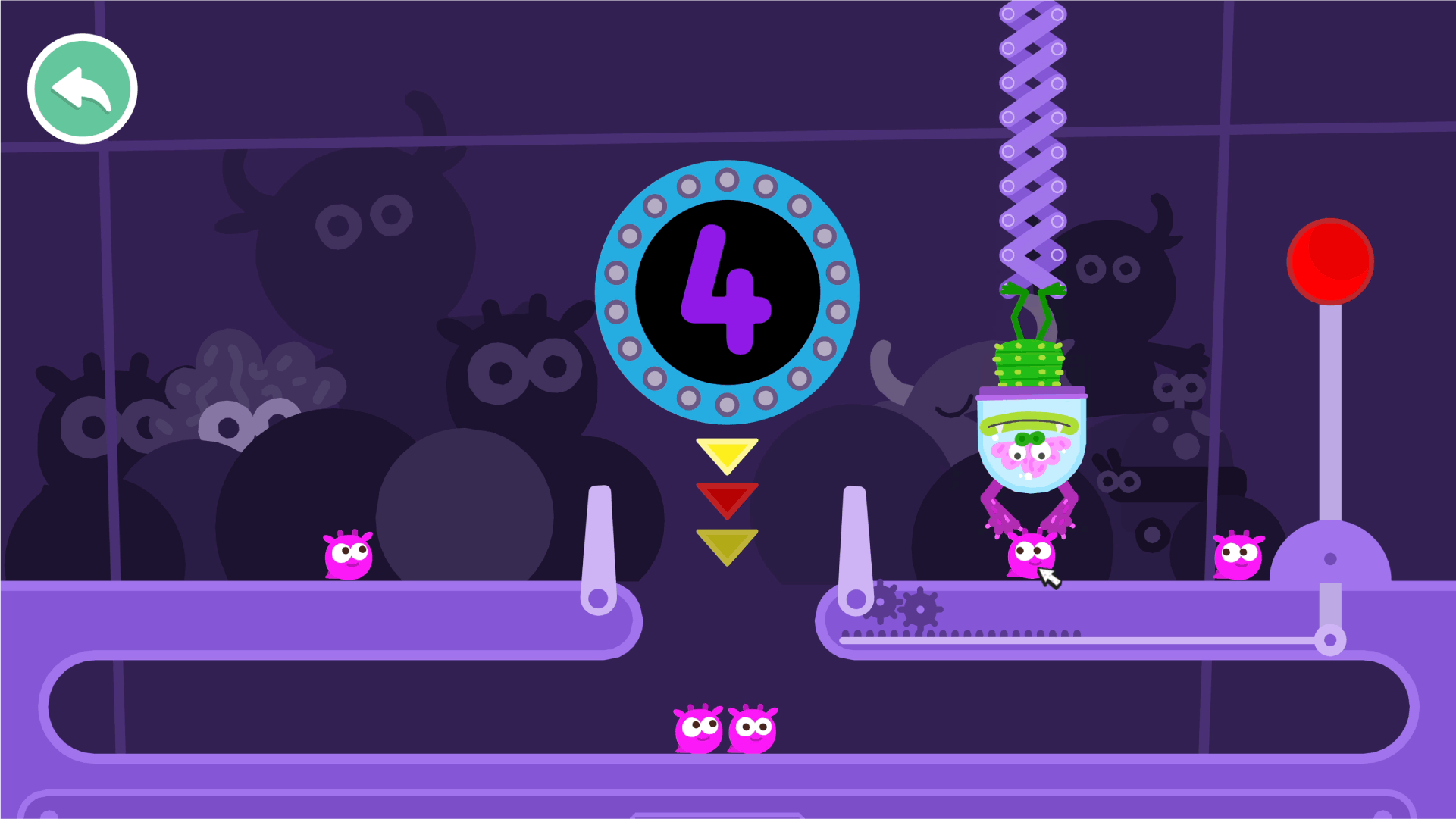
    For example, in Number Skills, there is a game where the child helps their monster, who is dangling by its feet, pick up the correct number of items and drop them down a hole (the Claw game). This was good fun, but some children found it confusing, as once you’d put too many things in the hole, there was no way to correct your mistake without pulling the lever to submit your incorrect answer.

    The claw game. A monster dangles by it's feet, attempting to make the number 4

    So we made it possible to remove items from the hole before submitting your answer, which was also fun and very intuitive for some users but was deemed by our experts to be potentially confusing and too advanced a concept for that stage of the game.

    So we ended up just giving the ‘incorrect’ feedback as soon as they’d dropped too many items in the hole, and reset the level so they could try again – which, based on our analytics data, has resulted in less frustration and greater engagement with the game.

    Out of all the things you’ve worked on at Teach Your Monster, what are you most proud of?

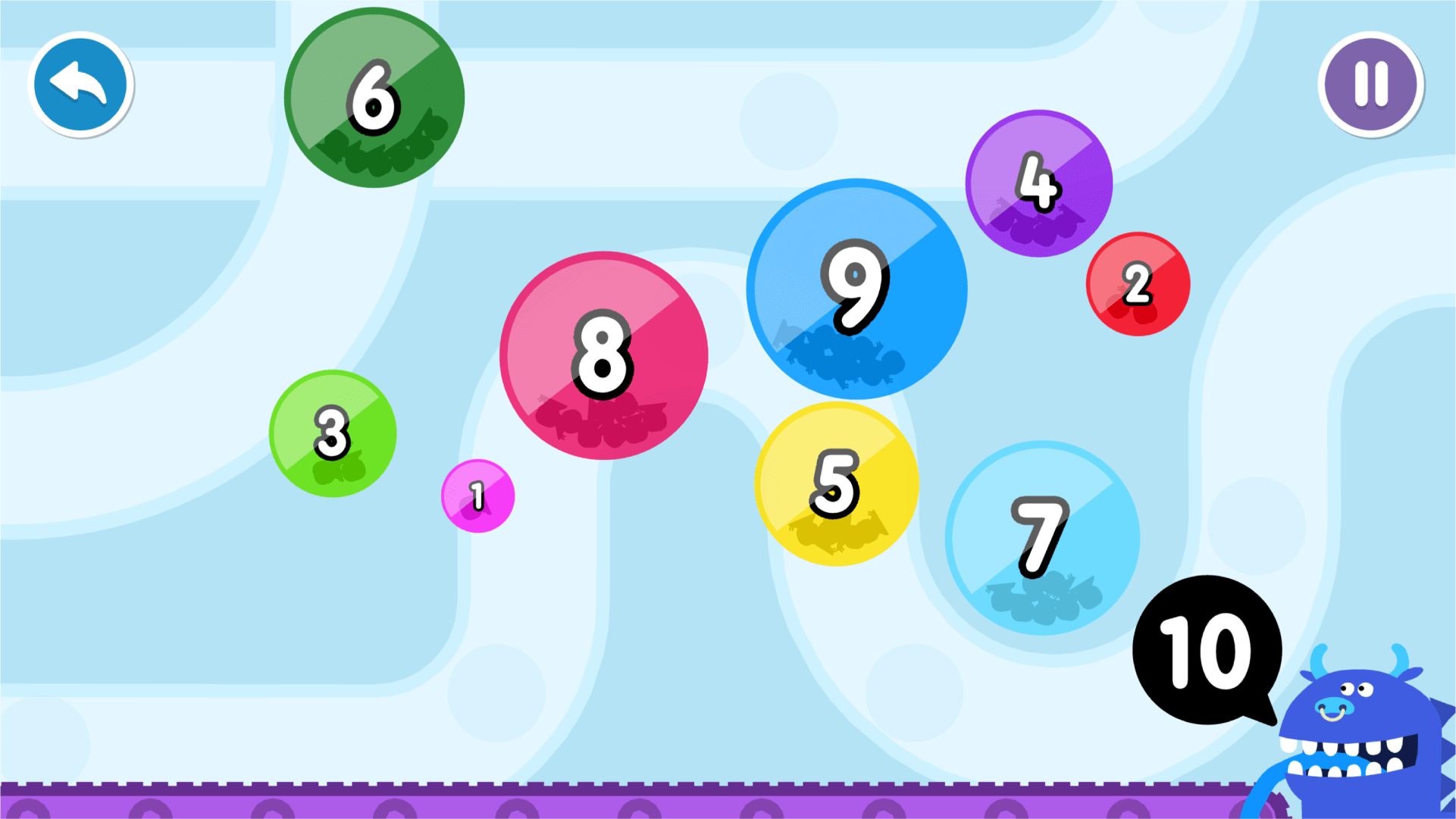
    The bubbles game from Number Skills. A dinocow asks for '10'

    On a personal level, I’m really pleased with how the Bubbles game in Number Skills turned out, as a fun way of composing and decomposing numbers in a very intuitive way.

    As part of the Teach Your Monster organisation, the sheer number of children who have played and enjoyed our games, whilst at the same time benefiting from our educational approach, is just amazing!

    If you’d like to check out Matt’s efforts, visit our Number Skills page here.

  • Phonics activities for everyone!

    Phonics activities for everyone!


    We have a lot of new parents and teachers starting to use our games this year, so we thought we’d get down to the basics for this article, with a quick introduction to phonics, and some engaging phonics activities suitable for both in-class and out-of-class use. 

    Phonics is the method of teaching reading and writing through the relationship of the sound (phoneme) and the written letter or letters (grapheme). For example, the ‘ai’ in the word ‘rain’ makes an /ay/ sound. This method of teaching helps children to decode words by breaking them down into their individual sounds, making it easier for them to read and spell. Although there are different programmes of teaching phonics around the world, many of them follow similar methods. 

    In my experience with early years classrooms, phonics is a daily practice, with lessons and activities centred around the letter-sounds they are currently learning. Lots of showing the letters and hearing the sounds, as well as more physical activities help children remember those letter-sound relationships, or to use the technical term, grapheme-phoneme correspondences (GPCs).

    Blending words in our game, Teach Your Monster to Read. A monster needs to choose the next letter for the word beginning 'ho'

    Our game, Teach Your Monster to Read, has been popular with teachers for over a decade for its engaging approach to teaching phonics. Whether used as a whole class activity, for one-to-one or group intervention or independent play, its repetitive structure and gamified way of teaching help reinforce those GPCs taught in class. Teachers can share the players login details with the family, making sure the progress they make in class is continued at home. 

    As part of our support for new teachers and parents, we’ve created a new FREE printable progress chart for Stage 1 of Teach Your Monster to Read – First Steps. Feel free to download, print and stick it on the fridge to get your kids excited about learning new letter-sounds. Mark each new letter sound learned with a smiley face or the ultimate honour… a sticker!

    A chart to track progress in Teach Your Monster to Read

    We’ve got loads of other printables to help with phonics, and have come up with a few ideas on how to gameify them even more. Print out and laminate (optional) our Phonics Flashcards to play these games: 

    Flip the waffle – Select a few that your child is working on. Place them face down on the floor and give the kid a spatula. Tell them to flip the waffle and say the letter-sound. If the child says the correct letter-sound, they get to cook the waffle! Have a pan or basket nearby for their collected waffles. Use the flashcards without the picture prompts to make it more challenging. 

    Push the button – Select a few GPCs that your child is working on. Roll up balls of playdough and place them on or in front of the card. Let your child press each ‘button’ as they sound it out for you. Roll out the balls to start fresh!

    Magic Monster Squares – Adapted this idea from playdoughtoplato – use our flashcards, put the focus one in the centre, draw some letters around it to form simple words. Keep to Consonant-Vowel-Consonant (CVC) words for younger children such as ‘sun’, hat, bus, etc. For lists of common CVC words, look at this useful article.

    HAPPY PHONICS LEARNING!

  • Fostering kindness in the classroom (and beyond!)

    Fostering kindness in the classroom (and beyond!)

    As teachers well know, coming back to start a new class can be hectic, to say the least. Amongst seating plans, lesson plans and establishing rules within the classroom, the children are also finding their place in their new environment. Summer was long and free, and returning to the classroom can be quite an adjustment. Understandably, this process isn’t quick or simple, and friction between classmates is often inevitable until things settle into place. 

    Establishing good student relationships is one of those things that is important to get right early on. Kindness can reduce stress, improve our mood, increase self-esteem, happiness and life satisfaction, create a sense of belonging (very important for a classroom environment), reduce loneliness and make the world a happier place by motivating others to be kind too!

    Fostering kindness in the classroom is definitely a challenge, especially after a particularly fraught playtime! Here we share some tips to help start the year off in the kindest way…

    1. Kindness to self
      It’s important that students are reminded to be kind to themselves first. Doing a little something for themselves each day, and giving some self-praise will help them feel good and fill them up with enough energy to be kind to others. Being kind to themselves when it’s much harder, such as when they make a mistake in their work, is the most important time to remind them of this. Phrases such as ‘mistakes are proof you are trying’ and positive language like this are examples that language teachers can model to their pupils. 
    2. Kindness to others
      Kindness can be a bit of an abstract concept to small children, so it can be a struggle to see where to start with being kind to others! Encourage them to start small and give practical examples. Acts such as picking something up for someone, opening the door for others, or making sure the classroom is tidy for your teacher are all small acts of kindness that help make someone else’s day shiny and happy!

      Once they’ve practised a few of these, this can lead to even bigger acts of kindness, such as playing with someone new at playtime, or drawing a picture for someone who needs cheering up. Whether big or small, these acts will make you feel good and make the classroom a nicer place to be. 
    3. Remembering that all things need kindness
      Big or small, old or young, everyone needs kindness. Showing a bit of patience for someone who takes a little more time to walk, bringing a cupcake to your neighbour or helping a trapped spider out of the house with a cup, are all great acts of kindness! 


    Want to bring more kindness into your classroom or home? Try these thoughtful and fun resources:

  • Adventures in language!

    Adventures in language!

    Learning to read English with Teach Your Monster

    We’ve had many reports that our phonics game has been very supportive for teachers working with students who have English as an Additional Language (EAL). We wanted to find out more, so we caught up with EAL specialist teacher Adon Polatka. Currently working in an elementary school (K-5) in Northern Kentucky, Adon has over 75 active EAL students, with 18 different languages represented in his caseload. 

    Having first downloaded the game in 2015, we were interested in what keeps Adon using it with his EAL students year after year. The answer came down to three key benefits: it supports foundational reading skills, adds a trusted and helpful tool to his teaching practice and builds important resilience in learners. 

    Supporting foundational reading skills:

    Teach Your Monster to Read is built on phonics progression and reading pedagogy, supporting children through the very first stages of learning letter-sounds, all the way to reading short sentences. A crucial phase that often comes a bit later for EAL students, Adon supports children in catching up to the stages of their native English-speaking peers, using the game to help. 

    “I used it a lot for my newcomers and younger primary students, and so for first, second, third graders who are new to our country and new to learning English and what the letter names are, what the sounds are that they make, and so I used the game as support so that they could start understanding the letters that they’re seeing in their classroom, and just found that it was really helpful for my students, so… brilliant.”

    Going deeper into this, Adon believes the interactive nature of the game enhances students’ engagement and retention.

    “The basic foundation of reading – what are the letters, what are the sounds – the game covers that in a fun way. It helps them to learn. They’re more motivated to learn and be engaged with it, as opposed to watching a YouTube video that’s just going over what the letters are.

    They’re not just sitting and receiving, they’re actually doing something to learn and be exposed to that content, which I think is unique, you know, like they talk about putting pen to paper and journaling – the action does something with your brain structure.

    There’s something I think that happens extra for them that is motivating, and they’re just more engaged as a learner, which helps them to acquire that skill and that content knowledge.”

    A trusted and helpful tool:

    The game was designed for children to engage with it independently of adult input. For Adon, this support enables him to implement a complementary approach between game-based learning and direct teaching in his English Language Arts groups. While he works one-on-one with one student, he trusts the game to support and progress the other students.

    “I’d have four or five students on the program, and then I would pull one of them at a time, and we’d work on either sight words or letter name fluency, letter sound fluency, a reading passage, to see where they’re at with their decoding skills.

    And so, while I would work with one student, the other students would be on that program just to get that support.”

    Furthermore, unique game-like structures promote continued engagement with the learning. Adon states that the children love that they can collect rewards on their adventures in game: 

    “They like getting the stars so they can modify their monster, which is really helpful. They know that if they keep working hard on it, they’ll get more stars, they can modify their monster and get fun things.”

    Building resilience:

    As well as supporting the kids in learning how to read, the minigames encourage children to keep trying, build resilience and increase reading stamina. 

    “I think, a good productive struggle for them, are the games where they have to hop across lily pads, and the word is ‘ring’, so they have to identify what’s the ‘r’ sound, what’s the short ‘i’ sound, what’s the ‘ng’ sound.

    They run into trouble with some of those blends or digraphs, short vowel sounds, but it’s really helpful for them because then they have to start over, and it repeats that. It gives them a chance to keep practising until they understand it.

    I think a lot of our students struggle with that grit and resilience as learners, and so I, as a teacher, appreciate them just practising and working through it. They know, ‘if I get this, I’ll get to the end of this particular minigame, and then I’ll be able to progress through the level’, so it’s a fun struggle for them.”

    For our final note, we asked Adon, “What does Teach Your Monster mean to you?”

    “Teach Your Monster to Read is helpful support for my students, that is fun and engaging. It’s educational, it’s supportive of them, and they’re trying to acquire skills in order to be able to read, in order to be more successful as a student in their classroom. I really appreciate it. 

    I enjoy seeing my students engage with it, and have fun with it, while learning. As teachers, we want our students to learn, but to see them enjoy that process is a great reward for me, so I’m really grateful for that.”

    If you’d like to read more or play the game, check out our Teach Your Monster to Read page.

  • Number Skills: Off-screen and Hands-on!

    Number Skills: Off-screen and Hands-on!

    At Teach Your Monster, we’re always looking for new ways to get more monster time in our day. So we thought about how great it would be to have some monster time without having to be on-screen – that’s where our printable resources come in. But just how to get the games off the screen and on to paper…?

    We wanted to try this with our Number Skills minigames, adapting them into fun, hands-on activities that could be played either in the classroom or at home. 

    Drawing on my knowledge of the Kagan Cooperative Learning principle of ‘creating cooperative learning opportunities’ for kids, whilst sticking to the Teach Your Monster belief that learning should be both enjoyable and educational, making these activities into playable partner games seemed like a natural fit.

    To begin, I used the original game graphics, simplifying them for easier understanding and to ensure they could be printed efficiently. Then it was onto the task of tackling the game mechanics and adapting them for a non-digital format. The transition from screen-based games to paper-and-counter versions required thoughtful consideration, especially when it came to keeping the spirit of the games intact.

    One example of this is the Rollercoaster Game, which focuses on number bonds to 10. In its original digital minigame, one player would be presented with a choice of two numbers in order to complete the number bond to make a number up to 10. 

    The rollercoaster game compared to the printable version of the game.

    In the paper version, a more collaborative approach was needed. One partner chooses a number for the other to create inside the number frame using counters. This setup adds a greater element of problem-solving, making the experience slightly more challenging. Thankfully, with two brains working together, this challenge becomes a fun and cooperative task!

    As well as the Rollercoaster Game, some of our other minigames have been adapted into partner games too: 

    Bumper Cars Game Numbers to 10 – This game helps students practice recognising numbers to 10 using printable sheets and counters. It’s perfect for reinforcing foundational math skills in a hands-on way.

    Monster Trucks Game Numbers to 20 – Like bumper cars, but with higher numbers! This activity helps children practice counting to 20. 

    Rollercoaster Number Bonds to 20 – A continuation of the original Rollercoaster Game, this version challenges students to practice number bonds to 20. Again, the game is designed to be played with a partner, reinforcing teamwork and collaboration.

    Dino Dash Arrays Game – practice arrays in a fun and engaging way. Based on the popular Dino Dash minigame, it can be played with printable resources to help children visualize and understand the concept of arrays.

    A child using the Dinodash printable game

    Click here to see, download, and play our fun Number Skills games today and try them out with your kids!

  • Reading for Fun Chapter 5!

    Reading for Fun Chapter 5!


    We get a lot of requests at Teach Your Monster for what our players want in our games, but we get an AWFUL lot demanding new chapters in Reading for Fun…

    ★★★★★ Best game ever but needs a new chapter  ·  I love this app so much!
    “The chapters are really funny with the goblin and the evil duck! But can you add chapter 5 soon, that will be very lovely” 

    ★★★★★ Chapter 5. I’m also your biggest fan! 
    “Dear Teach Your Monster teams, we are really excited for chapter 5! We have some cool ideas about the goblin and the evil duck can’t wait to see what you come up with!” 

    Well, we have exciting news! We are pleased to announce that Reading for Fun Chapter 5 has arrived! 

    Reading for Fun is our follow-on game from Teach Your Monster to Read, for children who have mastered their phonics and are confident at reading sentences. The great thing about Reading for Fun is that any sentence on-screen can be tapped or clicked, and it will be read aloud in the game, so even less-confident readers are supported with independent reading. With four extensive chapters until now, Reading for Fun has had 35 million plays in total with over 9 million books read. 


    Well, our team has been working hard over the past few months to bring this additional chapter, full of mystery and plenty of reading opportunities, including delivering invites, reading master plans, and even a brand-new book!  The latest chapter has five new parts of the story revealing a BIG secret about the Book-Eating Goblin… Can your monster and the villagers work together and distract the evil duck long enough to save the day?

    As well as Chapter 5, a new book is unlocked! The Book-Eating Dragon is a new book by Berbank Green and Rich Wake, all about a mad and misunderstood dragon and his terrible eating habits… play and find out how the villagers help the dragon through his woes. Complete Chapter 5 to earn “The Book-Eating Dragon” to add to your monster’s library – an exciting new reward for brave readers!

    Tell your kids to check out the new chapter and make new reading friends in Reading For Fun today!